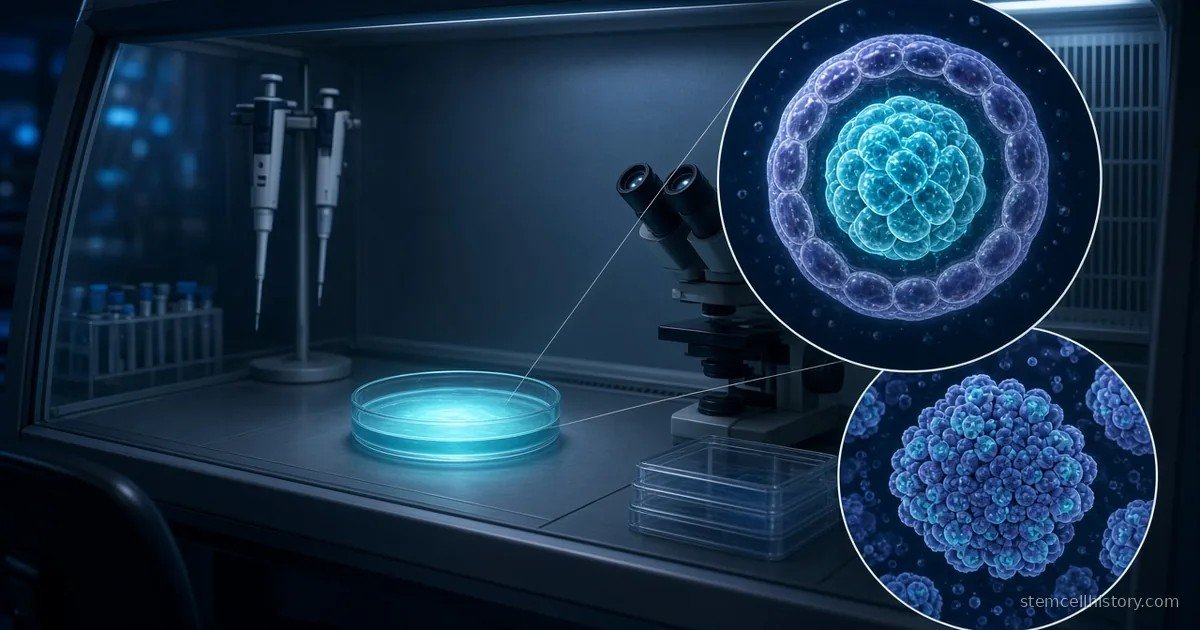
1998: James Thomson and the First Human Embryonic Stem Cell Lines
On November 6, 1998, Science published a short paper that changed stem cell research: James A. Thomson and colleagues at the University of Wisconsin–Madison reported deriving and continuously culturing pluripotent cell lines from human blastocysts. The same month, John Gearhart’s team at Johns Hopkins reported related pluripotent cultures from primordial germ cells. Together, those results moved human pluripotent stem cells from aspiration to reproducible laboratory tools—and into a lasting ethics and policy fight.
What Thomson’s team reported
The paper, “Embryonic Stem Cell Lines Derived from Human Blastocysts,” described lines with normal karyotypes, high telomerase activity, and surface markers typical of primate embryonic stem cells. After months of undifferentiated growth, the cells could still form trophoblast and derivatives of all three germ layers in teratoma assays. The embryos used were leftover from clinical in vitro fertilization and were donated with informed consent.
UW–Madison’s announcement the same day stated that the team had established five independent lines and could grow them indefinitely. Thomson framed the advance as opening research in developmental biology, drug discovery, and, over a long horizon, transplantation medicine. For basic vocabulary—blastocyst, inner cell mass, pluripotent—see this site’s glossary.
Gearhart’s parallel germ-cell work
Four days later, on November 10, 1998, PNAS published “Derivation of pluripotent stem cells from cultured human primordial germ cells,” from Michael J. Shamblott, John D. Gearhart, and colleagues. Those cells came from gonadal ridge tissue of 5- to 9-week postfertilization fetuses and most closely resembled embryonic germ (EG) cells. They could be passaged, kept a normal karyotype, and differentiated into endoderm, mesoderm, and ectoderm derivatives in embryoid bodies.
Thomson’s lines were embryonic stem (ES) cells from blastocyst inner cell mass. Gearhart’s were EG-like cells from primordial germ cells. Both were pluripotent human cultures announced in the same news cycle, and both were watched closely by clinicians, ethicists, and companies.
Why the funding was private
Federal money for deriving new human embryonic stem cell lines was constrained by the Dickey-Wicker Amendment, which since the mid-1990s has barred the use of appropriated funds for research in which human embryos are created or destroyed. Thomson’s Science paper thanked University of Wisconsin support and Geron Corporation. Geron, a California biotechnology company, also funded Gearhart’s Johns Hopkins work and related efforts elsewhere.
Private capital therefore carried the derivation step that federal rules made difficult to fund directly. That split—private derivation, later debates over federal use of existing lines—shaped U.S. policy through the Bush and Obama years, a story covered in How Policy Shaped U.S. Embryonic Stem Cell Research and on the legislation page.
WARF, patents, and access
The Wisconsin Alumni Research Foundation (WARF) pursued patents on the human embryonic stem cell technology and licensed commercial rights to Geron. Academic access and the scope of Geron’s exclusive rights later became contested; WARF sought to keep research licensing broad while disputing expansions of Geron’s claims. Whatever one thinks of patent strategy, the Wisconsin lines became reference materials for labs worldwide and for early regulatory discussions.
Ethics and public conflict
Because the cells came from human blastocysts, the 1998 papers immediately entered abortion politics, embryo research ethics, and church–state arguments. Supporters emphasized disease models and future cell therapies. Opponents objected to destroying embryos for research. Presidents, Congress, state governments, and courts spent the next decade drawing and redrawing funding lines. The science did not settle the ethics; it raised the stakes of an older dispute.
Clinically, no approved standard therapy in 1998 came directly from the new lines. The immediate products were research tools: cells that could be expanded, banked, differentiated, and compared across labs. That infrastructure is what later toxicity screens, disease models, and investigational cell products built on.
The bridge to induced pluripotent stem cells
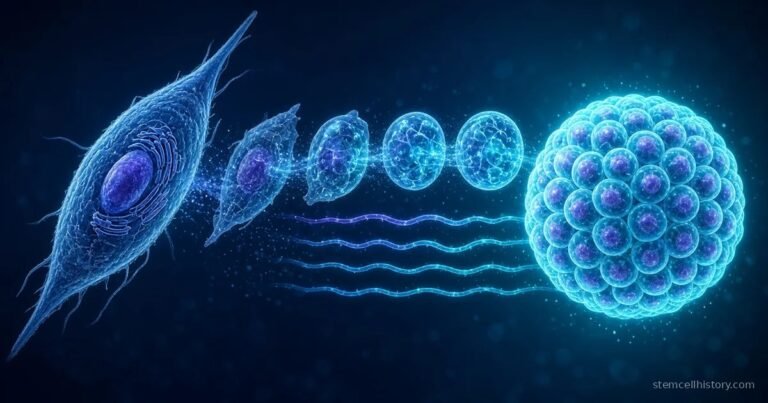
In 2007, Thomson’s group (Yu et al.) and Shinya Yamanaka’s group independently reported human induced pluripotent stem cells—reprogrammed adult cells with embryonic stem cell–like properties. That work did not erase embryonic stem cell research, but it added a route that does not require new embryo destruction for each new patient-matched pluripotent line. Our post on what iPS cells changed places 2006–2007 next to the 1998 foundation.
Internationally, other groups raced toward the same goal. Thomson’s prior work on nonhuman primate embryonic stem cells helped establish methods that transferred to human blastocysts. Once human lines existed, journals, funders, and companies treated pluripotent human cultures as a platform technology rather than a one-off curiosity.
Readers following policy should note the sequence clearly: derivation first under private support; then fights over whether federal funds could support research on already-derived lines; then, years later, induced pluripotent stem cells as an additional route. Confusing those steps flattens both the science and the law.
Why it matters today
Human embryonic stem cell lines remain reference standards for pluripotency assays, developmental studies, and some differentiated cell products in clinical testing. They also remain ethically contested. Understanding the November 1998 papers—what was shown, who funded it, and how patents and politics followed—is necessary context for later FDA frameworks, NIH guidelines, and today’s mix of embryonic, adult, and induced pluripotent approaches on the timeline.
The durable result was not a single therapy in 1998. It was a stable human pluripotent cell culture system, achieved under private funding rules shaped by Dickey-Wicker, and then fought over in public for a generation.
Sources
- Thomson J.A. et al. Embryonic Stem Cell Lines Derived from Human Blastocysts. Science. 6 Nov 1998;282(5391):1145–1147. DOI: 10.1126/science.282.5391.1145
- Shamblott M.J. et al. Derivation of pluripotent stem cells from cultured human primordial germ cells. PNAS. 10 Nov 1998;95(23):13726–13731. DOI: 10.1073/pnas.95.23.13726
- UW–Madison News, Nov 6, 1998: Wisconsin scientists culture elusive embryonic stem cells
- UW–Madison News on WARF, Geron licensing, and research access
- NIH Stem Cell Information
This article is educational history only. It is not medical advice and does not recommend treatments.