Urine-Derived Stem Cells: What They Are and What They Can Actually Do
Ask most people what’s in urine and “stem cells” is not an answer they’d usually guess.
Yet for more than a decade, researchers have been quietly harvesting a small, resilient population of stem-like cells shed into urine and using them for everything from kidney disease research to bladder tissue engineering. Because the name sounds similar to fringe practices like drinking urine for health (“urine therapy”), urine-derived stem cells (USCs) get lumped in with pseudoscience they have nothing to do with. This article separates the real biology from the noise.
What Are Urine-Derived Stem Cells?
Urine-derived stem cells are a rare population of self-renewing cells found in urine that were first systematically isolated and characterized by researchers including Dr. Yun Zhao’s group in China in the early 2010s, building on much earlier observations by Sutherland and Bain, who reported exfoliated cells in the urine of newborns as far back as 1972.
These stem-like cells aren’t manufactured by the body specifically to appear in urine – they’re shed from the lining of the urinary tract. The leading evidence points to an origin in the upper urinary tract: the renal pelvis, ureters, bladder, and urethra, with some studies suggesting a contribution from cells associated with the kidney’s nephron structures. Once isolated from a urine sample and expanded in the lab, they display a phenotype similar to mesenchymal stem cells (MSCs) — the same broad stem cell family found in bone marrow and fat tissue — while also carrying some markers associated with pericytes and early urothelial (bladder-lining) cells.
A few properties make them scientifically interesting:
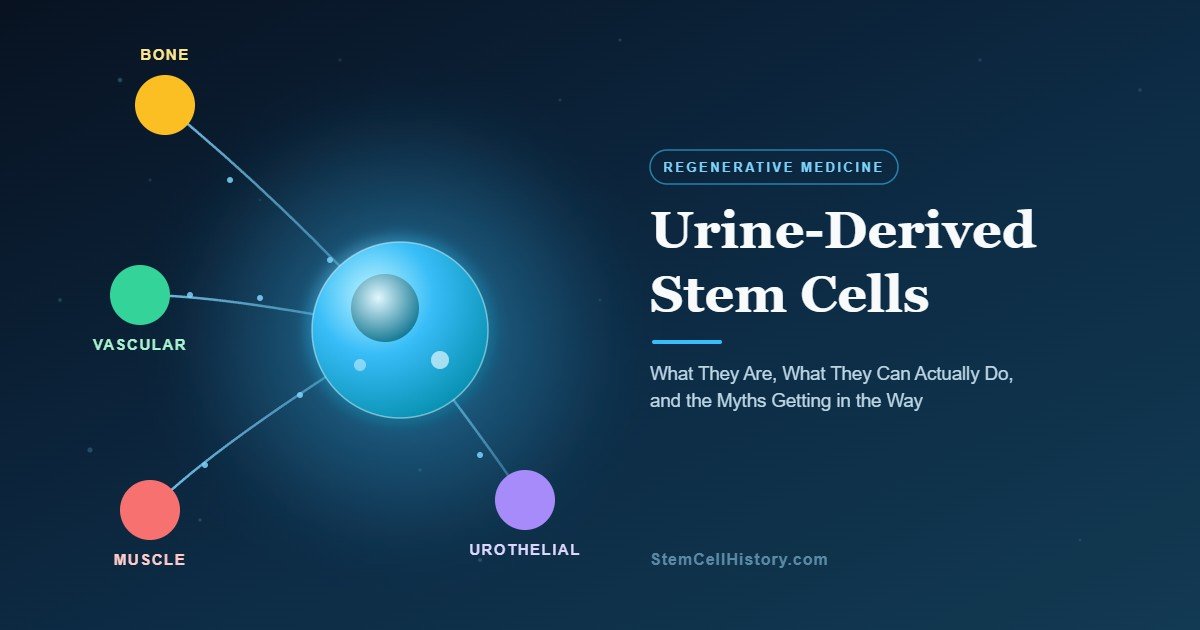
- Multipotent, not pluripotent (in their natural state): They can differentiate into mesodermal lineages such as bone cells (osteocytes), cartilage cells (chondrocytes), fat cells (adipocytes), and muscle and endothelial cells, as well as some endodermal lineages like urothelial cells.
- High proliferative capacity: USCs show high telomerase activity and long telomeres, meaning they can be expanded through many population doublings in culture without prematurely aging or losing a normal chromosome count.
- No teratoma formation: Unlike embryonic stem cells or induced pluripotent stem cells (iPSCs), USCs in their multipotent state do not form teratomas (a type of tumor) when transplanted — an important safety signal for a cell type being considered for therapeutic use.
- They can be reprogrammed: USCs are also a popular starting material for making induced pluripotent stem cells (iPSCs) — adult cells reprogrammed back into an embryonic-like state. This was formalized in landmark papers describing how to generate iPSCs from urine samples, later expanded into a detailed step-by-step protocol.
Why Urine, of All Things?
The appeal isn’t that urine is somehow special biologically — it’s practical. Compared with other stem cell sources, collecting urine is:
- Completely non-invasive. No biopsy, no bone marrow aspiration, no surgical fat harvesting, and no embryo involved.
- Repeatable. A new sample can be collected essentially on demand, which matters for longitudinal research and personalized disease modeling.
- Low-cost and low-risk. There’s no procedural risk to the donor, which lowers the barrier for research participation, including in children.
- Ethically uncomplicated. Because USCs are adult somatic cells (and any iPSCs made from them are derived without destroying an embryo), they sidestep the ethical debates associated with embryonic stem cells.
The tradeoff is yield: a typical urine sample contains only a handful of these cells, so labs must culture and expand them over one to three weeks before there’s enough material to work with. This is a genuinely limiting factor, not a minor technicality — see the myths section below.
What Can They Actually Be Used For?
It’s worth separating two very different buckets: what’s established in research and preclinical models, and what’s available as an actual medical treatment today (very little, so far).
1. Research and disease modeling
This is where USCs have had their biggest impact to date. Because they can be collected non-invasively and reprogrammed into iPSCs, they’ve become a favored tool for:
- Modeling genetic and rare diseases in a dish using cells derived directly from a patient (for example, lupus and phenylketonuria have been modeled this way).
- Drug toxicity screening, particularly for testing how drugs affect kidney (nephrotoxicity) and other tissues, since the cells carry a “urological” identity.
- Biomarker discovery for kidney and urinary tract disease.
2. Preclinical regenerative medicine
Across animal models and lab studies, USCs and the extracellular vesicles (tiny secreted particles, sometimes called exosomes) they release have shown:
- Kidney injury repair: Anti-inflammatory, anti-fibrotic, and pro-regenerative effects in models of acute kidney injury and chronic kidney disease, largely through paracrine signaling (the cells secrete helpful factors rather than necessarily engrafting long-term).
- Bone, cartilage, and skin repair: Differentiation into osteocytes and chondrocytes has been explored for bone and joint repair, and USCs have shown wound-healing potential in skin models.
- Cardiovascular and endothelial regeneration: Emerging work looks at USCs’ potential to support blood vessel repair and endothelial function.
- Urinary tract tissue engineering: Because of their urological origin, USCs have been used to grow urothelium with barrier function in the lab — relevant for future bladder or urethral reconstruction.
- Neurological and musculoskeletal applications: Early-stage research is exploring roles in nerve and muscle-related conditions.
3. Actual clinical use
Here’s the honest state of things: as of today, urine-derived stem cell therapies are not an FDA-approved treatment for any disease. The vast majority of the promising results above come from cell culture experiments and animal studies. There are early-phase clinical trials in areas like kidney disease, but a therapy moving from “shows anti-inflammatory effects in a mouse model of kidney injury” to “approved treatment you can receive at a hospital” typically takes years of further trials. Anyone marketing a urine-derived (or any) stem cell injection today as a cure for a serious disease outside of a registered clinical trial should be treated with real skepticism.
Myths vs. Facts
Myth: “Urine-derived stem cells” means drinking urine, or is related to “urine therapy.” Fact: These are unrelated concepts. Urine-derived stem cells are laboratory-isolated cells extracted from a urine sample and cultured under sterile conditions in a lab — they are never something you’d ingest. “Urine therapy” (sometimes called urotherapy or shivambu) is a folk/alternative-medicine practice involving drinking or applying urine, and it has no credible scientific evidence supporting any health benefit. The similarity in name is the only thing these two topics share.
Myth: You can get a urine stem cell treatment for anti-aging, injuries, or chronic disease at a clinic today. Fact: With rare exceptions inside registered clinical trials, no urine-derived stem cell therapy is FDA-approved. The FDA has repeatedly warned consumers about clinics offering unapproved stem cell products (of various types, not just urine-derived) with unsubstantiated claims, and has documented real harm — including cases of blindness from unproven stem cell injections. If a clinic is charging for a “stem cell cure” outside a legitimate, registered trial, that’s a major red flag.
Myth: Urine is packed with easily harvested stem cells, so this is a simple, effortless source. Fact: The actual yield is very low — only a small number of viable cells are typically recovered per sample — and they must be expanded in culture for one to three weeks before there are enough for experiments. It’s non-invasive, not effortless.
Myth: Urine-derived stem cells are the same as embryonic stem cells. Fact: In their natural state, USCs are adult, multipotent somatic cells with a more limited differentiation range than embryonic stem cells, which are pluripotent (able to become virtually any cell type). USCs can be reprogrammed into pluripotent iPSCs in the lab, but that’s a separate, deliberate process — not something urine cells do on their own.
Myth: Because they come from urine, these cells are risky or “dirty.” Fact: Cells are collected under sterile lab technique from a fresh urine sample and go through wash and culture steps before any experimental or research use; contamination is a standard lab-control issue, not a special risk unique to this cell source. Separately, studies have found USCs maintain a stable, normal chromosome count (karyotype) through multiple passages and do not form teratomas in their multipotent state — both reassuring signs for safety research, though this is not the same as being an approved therapy.
The Bottom Line
Urine-derived stem cells are a real, actively studied, and genuinely useful research tool — not a wellness myth, and not (yet) an approved medical treatment. Their biggest current value is in disease modeling, drug safety testing, and generating patient-specific iPSCs without invasive procedures. Their biggest future potential, still mostly in animal models and early trials, is in kidney repair, urinary tract tissue engineering, and regenerative applications for bone, cartilage, skin, and blood vessels. The gap between “promising in the lab” and “available as a treatment” is exactly where misinformation and predatory clinics tend to move in — so any specific therapeutic claim is worth checking against peer-reviewed evidence and clinical trial registries before taking it at face value.
Further Reading & Sources
- Bharadwaj, S., et al. “Urine derived cells for human cell therapy.” — foundational characterization work.
- Guan, J., et al. (2024). “Urine-derived stem cells: Promising advancements and applications in regenerative medicine and beyond.” Heliyon / ScienceDirect.
- “Application prospects of urine-derived stem cells in neurological and musculoskeletal diseases.” PMC, 2024.
- “Beyond waste: understanding urine’s potential in precision medicine.” Trends in Biotechnology, 2024.
- “Urine-derived stem cells in kidney disease: progress, challenges, and future directions.” PubMed, 2025.
- Zhou, T., et al. (2012). “Generation of human induced pluripotent stem cells from urine samples.” Nature Protocols.
- “Urine-derived stem cells: applications in skin, bone and articular cartilage repair.” Burns & Trauma, Oxford Academic.
- Wake Forest Institute for Regenerative Medicine. “Urine-derived Stem Cells May Prove Therapeutic for Kidney Failure.”
- U.S. Food and Drug Administration. “FDA Warns About Stem Cell Therapies.”
This article is for educational purposes and does not constitute medical advice. Anyone considering a stem cell-related treatment should consult a qualified physician and verify the treatment’s regulatory and clinical trial status.